Stairs and Railings
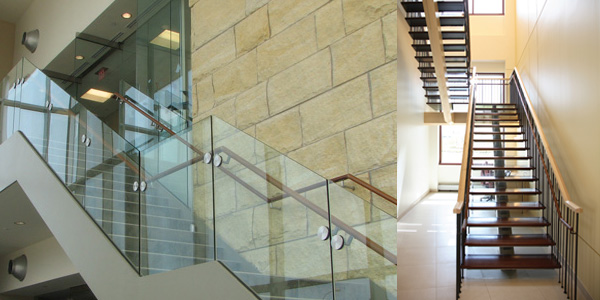
Stairs can be utilitarian or they can be used to create a sense of drama. Chicago Architectural Metals has experience designing, fabricating, manufacturing and installing all types of stairs. Recently we have completed stair projects for Barney's Department store, the Wrigley Global Innovation Center, Elmhurst Medical Center and The Chicago City Center among many others
Decorative Metal
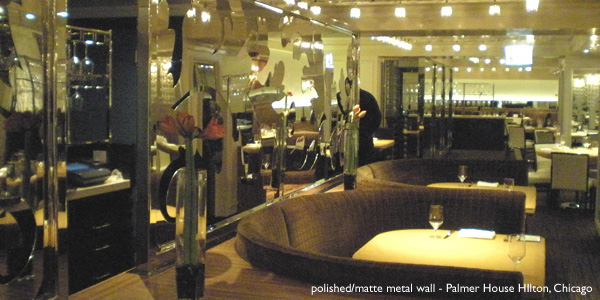
Decorative metal accents can make a dramatic difference in an architectural scheme whether it be located on the interior or exterior. Chicago Architectural Metals has worked on many historically significant buildings. One of our recent projects was done for the Palmer House Hilton in downtown Chicago.
Utilizing contrasting polished and matte metal, the decorative wall shown above creates an artistic backdrop for the hotel lounge as well as 'opening up' the space, by way of mirrored reflection.
The historic Palmer House Hilton can be found at:
17 E. Monroe Street, Chicago
Chicago Ornamental Iron
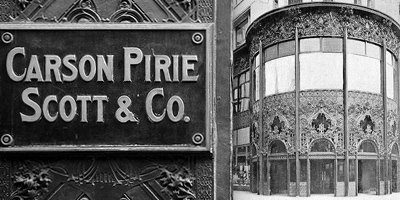
Chicago Ornamental Iron, established in 1893, specialized in decorative metal work for some of the foremost designers of the early 1900s including many from the Prairie School of Architecture including Louis Sullivan and Hentry Trost.
Though primarily working in Chicago, the company gained national exposure with the Carson, Pirie, Scott building designed by Sullivan, built between 1898-1906, and located at 1 State Street in downtown Chicago.
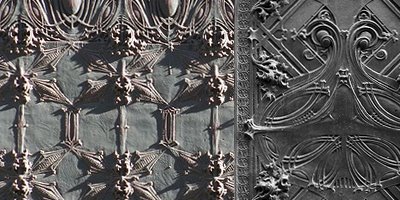
Chicago Ornamental Iron created flowing cast iron ornamentation on the first two floors in the characteristic art nouveau style Sullivan preferred giving the structure a feeling of opulence and artistic expression not seen in other high rise buildings of the era.
Today, Chicago Ornamental Iron strives to continue and maintain the high standards set by the original company, safeguarding its legacy of integrity, craftsmanship and quality.

Some of our recent projects include the Oak Street Sculpture, and interior decorative gatework for Barney's, both located at the busy corner of Oak and Rush Streets in Chicago's Gold Coast district.
Visit the Chicago Ornamental Iron website: www.chicagoornamentaliron.com
Rick Joy, Avra Verde
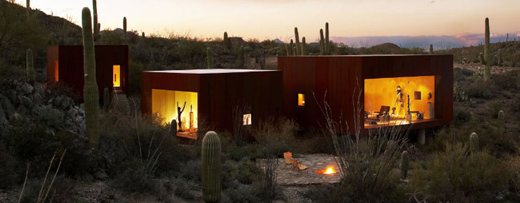
The book Rick Joy: Desert Works has been out for a number of years now, but it's still a great resource for metal architectural inspiration.
Originally from the East Coast, Rick Joy studied music before he began his architectural studies at the University of Arizona in Tucson.
Many of his projects, like the Avra Verde shown above and featured below, are private residences in the desert. His style, though minimalist and contemporary, has a sense of warmth not always found in this architectural genre. The natural materials work in sync with the organic nature of the desert. In the architect's own words -
"The simplest things can evoke the deepest feelings. The silence in great music is often more profound than the sounds."
Avra Verde
The Saguaro National Park West
Rick Joy: Desert Works, by Rick Joy
Princeton Architectural Press; 1 edition (June 1, 2002)
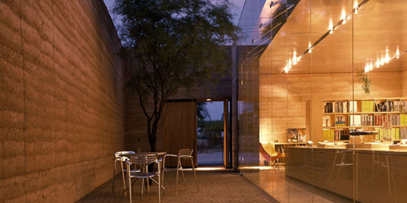
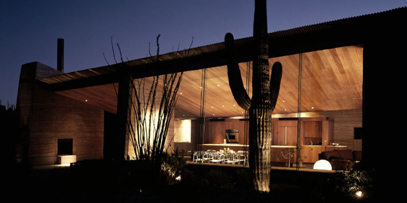
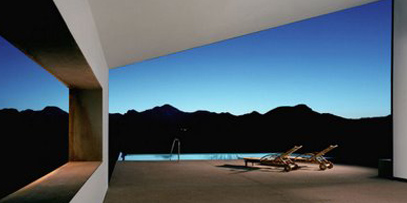
Seven Exclusive Desert Pavilions on forty acres, located at The Saguaro National Park West. This project is to promote an indoor-outdoor lifestyle merging sensory experience, artisanship, and environmental sensibility; to create the most unique private residence enclave in the American Southwest.
The use of raw, untreated steel works exceedingly well here in the Desert, reminding one of rusty cans or abandoned auto carcasses. The house is ingeniously angled to exploit precisely framed views in all directions and the overall effect is serene and sophisticated.
-Architect's Statement
For more information please visit the Avra Verde website:
http://www.avraverde.com/
Modernist Metal Architecture
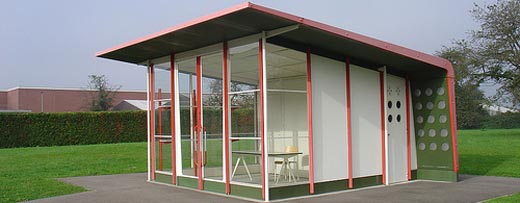
Jean Prouvé Gas Station Designed with his brother Henri in 1951 for Socony-Vacuum/Mobil Oil
Jean Prouvé
1901-1984
Born in Nancy, France Jean Prouvé trained as a metal smith before becoming an engineer. His early work in metal formed the foundation for both his architectural and furniture designs.
Prouvé began producing his own metal creations upon opening his workshop in 1923, producing mostly lamps and handrails. In 1931 he opened Ateliers Jean Prouvé and began collaborating with some of the most iconic artists and designers of the era including Le Corbusier, Sonja Delaunay and Charlotte Perriand (see shelving - Bibliotheque, below).
Like many architects and designers of the Modernist era, Prouvé was intrigued by the materials and how they could be used to create efficient and affordable design for the masses, however, unlike the Bauhaus, he was interested in working with sheet metal rather than the tubular metal made so popular by Marcel Breuer and others. This exploration led to the Standard chair (1934) and the Antony chair (1954) - two of the most collectable modernist pieces today.
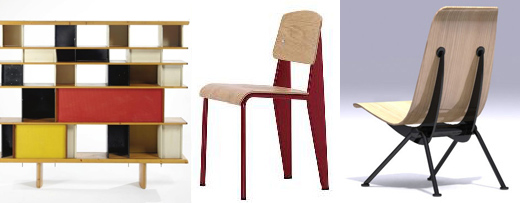
Bibliotheque, Standard chair, Antony chair
In the 1950s, Prouvé abandoned furniture design and devoted his time to the idea of prefabricated architecture. He is considered a pioneer in this field, the Tropical House built in 1949 for use in Africa, being an example of this.
Designed to be very portable and green, the house is constructed of aluminum and steel. Prouvé's idea being to design a structure with the minimum number of pieces, light weight enough to be carried by two people, and the ability to ship flat for efficient cargo transport.
Though the design was a success, it should be noted that it was never mass produced after the initial prototype was made due to lack of funding.
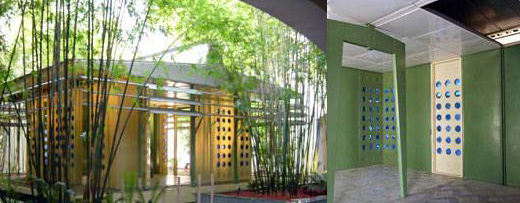
Tropical House exterior and interior, from the past exhibit at the Hammer Museum in Los Angeles
For years, largely unknown in the States, today with the increased popularity and interest in Modernist design, Jean Prouvé's work is once again gaining recognition. His furniture is among the most desired by Modernist collectors, and can be found on display at the Vitra Design Museum and on numerous sites throughout the web.
|

